
The short version: Seeking Alpha ($299/yr Premium) is the largest library of investor-written analysis anywhere, wrapped around quant ratings with a strong public track record. You read other people’s theses.
Stock Rover ($348/yr Premium, billed annually) is where you build and test your own: 800+ screening metrics, up to 20 years of fundamentals, research reports, and brokerage-synced portfolio analytics.
The one-line difference: Seeking Alpha tells you what other investors think. Stock Rover shows you what the numbers say, including your own portfolio’s.
| Capability | Stock Rover | Seeking Alpha |
|---|---|---|
| Price | Premium $29/mo billed annually · $348/yr | Premium $299/yr · Pro $2,400/yr |
| Free trial | 14 days, no credit card | Intro offers; card required |
| Human-written analysis | ✗ | Tens of thousands of contributors |
| Quant ratings | Stock Rover scores & rankings | Well-known quant grades |
| Screening | 800+ metrics, equations, percentiles | Screens on grades & core metrics |
| Fundamental history | up to 20 years in-app | Shallower in-app depth |
| Brokerage sync & portfolio analytics | ✓ every tier + performance report | Linked portfolios, article-centric alerts |
| Mutual fund & ETF research reports | 7,400 ETFs + 20,000 funds (Ultimate) | ETF articles & grades |
| Dividend history & forecasting | 30 years + projections | Dividend grades & articles |
| Earnings coverage & news flow | News feed on holdings | Fast, deep, transcript-linked |
Read “this stock’s FCF yield is top-decile for the sector” on any site; in Stock Rover you verify it in one percentile screen, then check ten years of the underlying series. A data platform turns opinions into checkable claims.
Link your accounts and the Portfolio Performance Report answers what no article can: your actual IRR vs time-weighted return, what drove your balance, your risk vs the index, projected dividend income, and your funds’ fees in dollars.
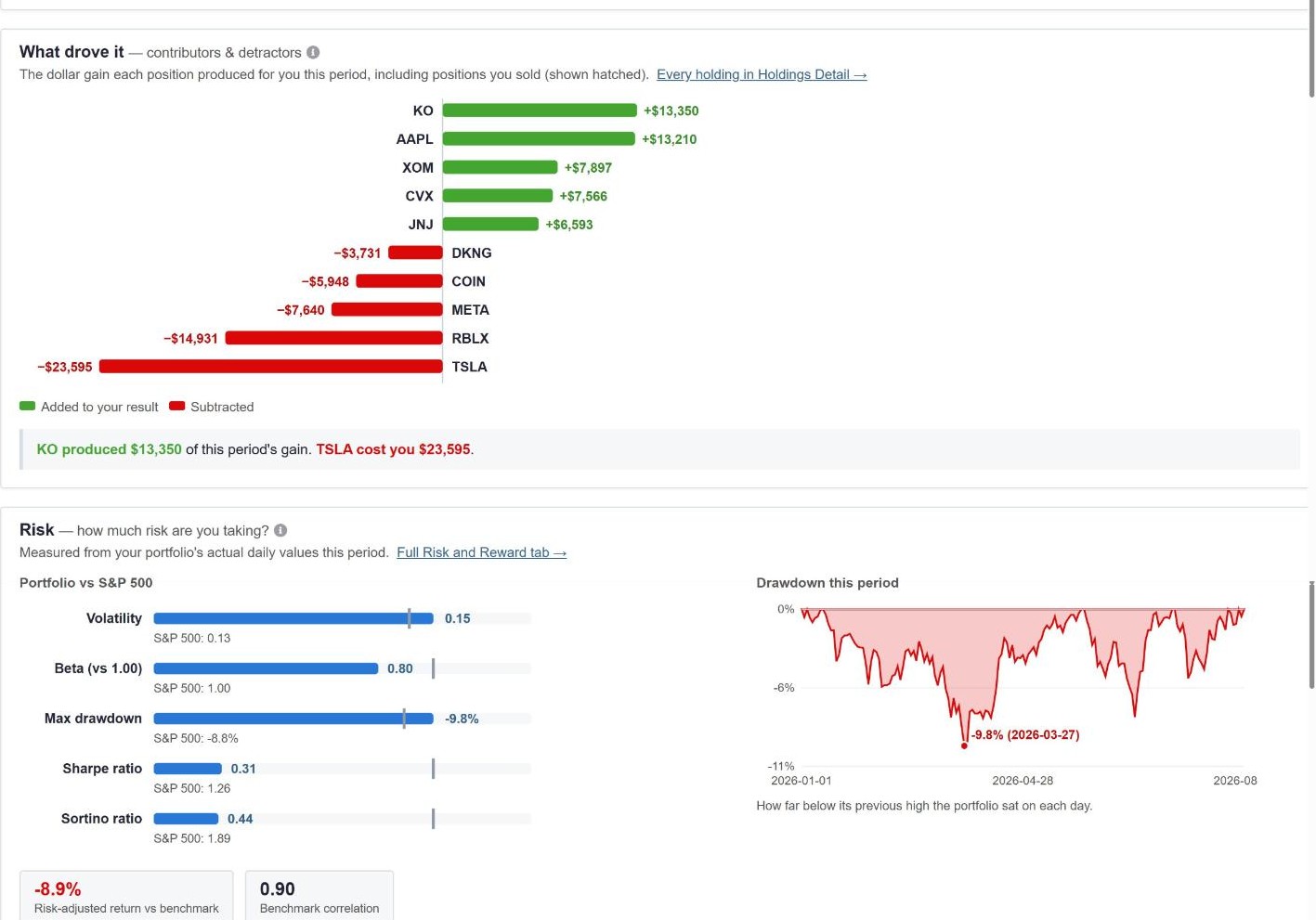
What no stock-picking article can tell you: what your own decisions produced, in dollars, with the risk you took.
Instead of waiting for a contributor to cover your niche, define it: equation screening across 800+ metrics, ranked by percentile, alertable when new names qualify.
Volume and speed of coverage. Thousands of tickers get written up within hours of earnings, with bulls and bears arguing in the comments. There is nothing like it, including in Stock Rover. Quant grades have a published, credible track record. Transcripts live there. If your process starts with reading smart disagreement, Seeking Alpha is worth its fee.
Seeking Alpha for narrative, disagreement and earnings-day coverage; Stock Rover for verification, screening and everything involving your actual money. At $348/yr, adding Stock Rover Premium to a Seeking Alpha subscription costs less than most single losing trades.
Seeking Alpha only: you invest by reading, weigh others’ theses, and track a compact portfolio informally. Stock Rover only: you invest by numbers, run screens, and want institutional-grade reporting on your accounts. Both: you read for ideas and verify before you buy. That is the workflow we’d bet on.
They do different jobs. Stock Rover is stronger for screening, fundamental data depth and portfolio analytics; Seeking Alpha is stronger for written analysis, earnings coverage and community debate. Many investors productively use both.
If you read investing analysis weekly and use the quant grades, yes. If you mostly need data, screening and portfolio tracking, for similar money a Stock Rover subscription buys the data side instead: $348/yr for Premium on annual billing, with screening, history and portfolio tracking.
Seeking Alpha screens primarily on its grades and core metrics. Stock Rover offers 800+ metrics with freeform equations, percentile ranking and historical screening; a different depth class.
More deeply: brokerage sync at every tier plus a trade-history-based performance report with IRR vs time-weighted return, risk metrics, income projection and fund-fee analysis.
Yes: 14 days, full-featured, no card required.
Pick any stock you read about this week and check its 20-year numbers and sector percentiles in the trial.
Maintained by Stock Rover. Facts last verified October 1, 2026. Seeking Alpha pricing from seekingalpha.com/subscriptions. Corrections welcome. See also: all comparisons · vs Koyfin · plans & pricing.